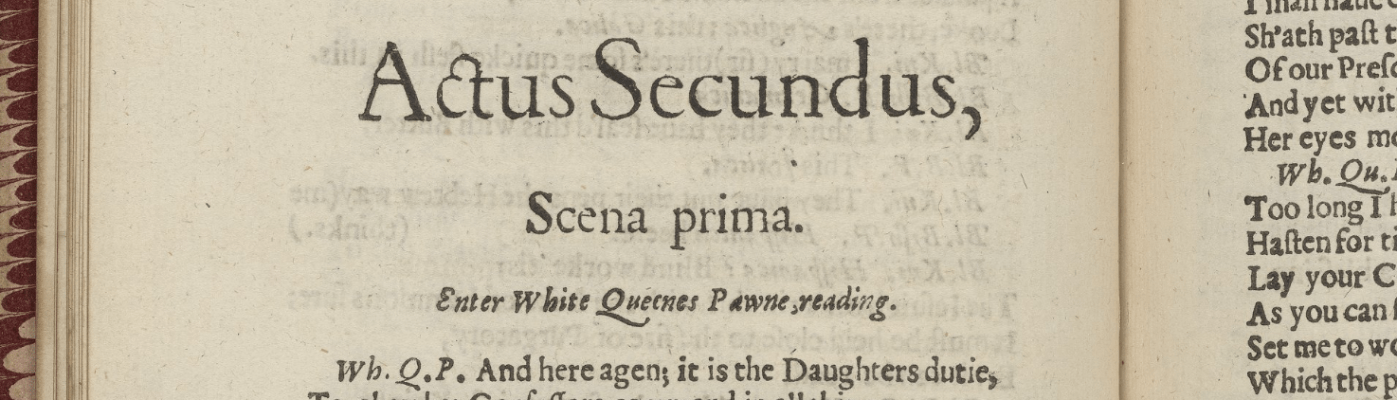

On 27th July 2023 we discussed the Introduction to Laurie Maguire’s The Rhetoric of the Page, as suggested by Mirjam Haas. Mirjam prepared the following prompts for us:
Early modern typography is full of blanks—small localized units of text (a word, a phrase, an incomplete line) or larger units of blank space (lines, paragraphs, a page)—that invite readers to respond imaginatively to what is absent, interacting with typography to make meaning (which is, after all, simply a definition of reading).
Maguire 5
Laurie Maguire’s Introduction to her 2020 book The Rhetoric of the Page thinks about the role blanks play on early modern pages of text. Moving between book studies and rhetorical approaches to (performative) text, the book is guided by reader-reception theory (see quote above and page 8). It suggests that “Obliterature” (4) or “blotterature” (5) holds the potential to multiply and add to rather than reduce and obscure meaning.
Prompt 1: I came across Maguire’s book while researching silence for one of my Woman in the Moon chapters, thinking about the typographical blank as a manifestation of silence on the page that triggers/represents silence(s) on stage. I think mine is a slightly different approach than Maguire’s as she seems to suggest that the blank – though not something ‘insufficient’ or ‘mistaken’ – still stands in for ‘something else’. A ‘something else’ as imagined by the reader. At least in what I do, the blank, however, stands in for actual material silence – and silence is meaningful in and of itself in (dramatic) conversation. So my question is: must the blank necessarily invite the reader to imagine ‘something else’ or can it just stand in for a literal and/or figurative silence (of some kind) that makes meaning all the same?
Prompt 2: Maguire brings in many fascinating examples of blanks from many literary contexts and time periods – if you have little time, I actually recommend just reading the first paragraph and then to go through the examples, you should get a pretty good idea of what she is after just by doing that! – when I do similar things, I’m told off very quickly by my supervisor (stick to your period and genre!). What do you make of the variety of textual examples? Does it hinder or help with conceptualising the issue at stake and/or with structuring the introduction in general? Does it add relevance? Does it maybe have something to do with this book being based on a lecture series for (presumably) a more general audience?
Prompt 3: Maguire ends her Introduction by quoting Levenston “for ‘nothing is more calculated to remind a reader he [him again!?] is reading than the deliberate foregrounding of graphic form’” (23) – what do you make of this statement? Does this – and/or blanks in general – play a role in your projects?
For a monthly reminder of upcoming reading groups, you can sign up to our mailing list.
 Revels Office