
On Monday 25 November we discussed “Materiality and the Stage”, led by Mirjam Haas. Our text, Catherine Richardson’s 2019 ‘”More things in heaven and earth”: Materiality and the Stage’, provides a relatively recent overview over the field, serving as an introduction – or reminder for those of you already invested in the field – of what the so-called ‘New Materialism’ in Shakespeare studies is all about. It outlines recent developments and approaches, while also asking critical questions about where the field is at present and where it might go in future.
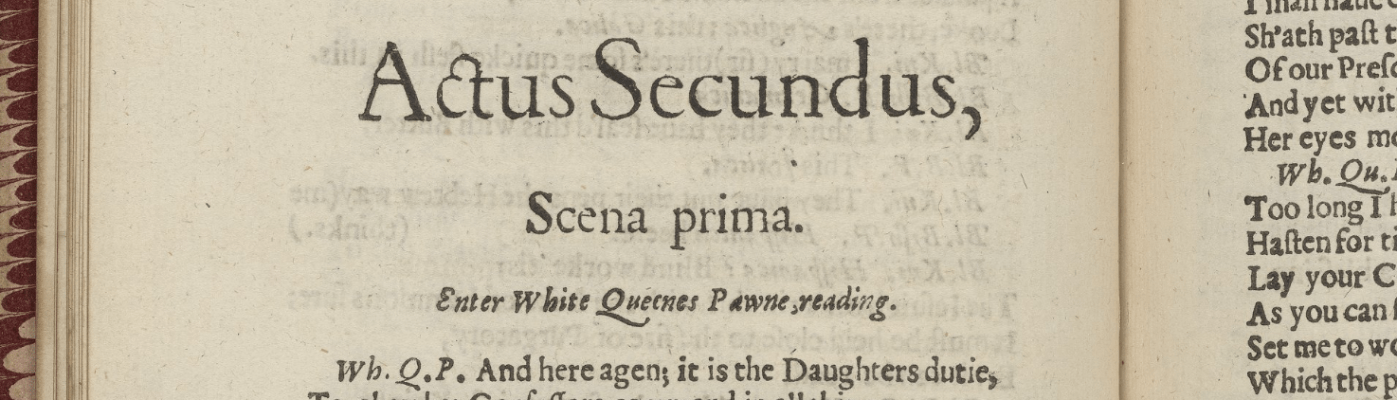
The starting point for research on materiality is the object. Whether that is a prop on stage or a description of an object on the page, e.g. the strawberry handkerchief in Othello. It can also, though, mean the theatre itself as an object – the theatre as a (historical and lost) architectural space as well as the objects of the theatre excavated during archeological digs. To make this more complicated, we can also think of text itself as an object, e.g. a specific copy of the First Folio and the traces its users have left behind on its pages over the centuries.
Richardson explores how this wide field of studies challenges our current mode of working mostly based on textual sources, whether these are the play texts themselves or sources providing early modern contextual evidence. Richardson describes a general trend in the study of history moving away from a focus on elite, male written culture towards everyday material culture accessible to all classes and genders. These new(ish) objects of study also call for new methodologies (how can we read an object?) that challenge old modes of reading as well as working strictly within one discipline.
What I suggest we focus on for our discussion next week, then, are the issues and questions Richardson raises: time, text, gender, social implications, speculation (as a method), new and borrowed methodological approaches, interdisciplinary work and co-authorship. One of the main difficulties she stresses here is that if we think of theatre from the material (vs. the textual) side, we can no longer easily ‘fix’ it in time or space:
We tend to feel more rooted, as researchers, by temporal precision. It makes it easier to build contexts and to think synchronically. But material theatre is not the same as object study. Our subject is more diffuse, and dynamic in different ways to that of the economic historian studying flows of imports, or the art historian investigating the biography of an artwork. We deal in conjunction – in the brief sliding together of bodies and things in space – that is the challenge and the excitement of the early modern stage as a materially based subject (89).
Looking at early modern theatre through the lens of Materiality, then, provides both challenges and opportunities.
For a monthly reminder of upcoming reading groups, you can sign up to our mailing list.
 Revels Office